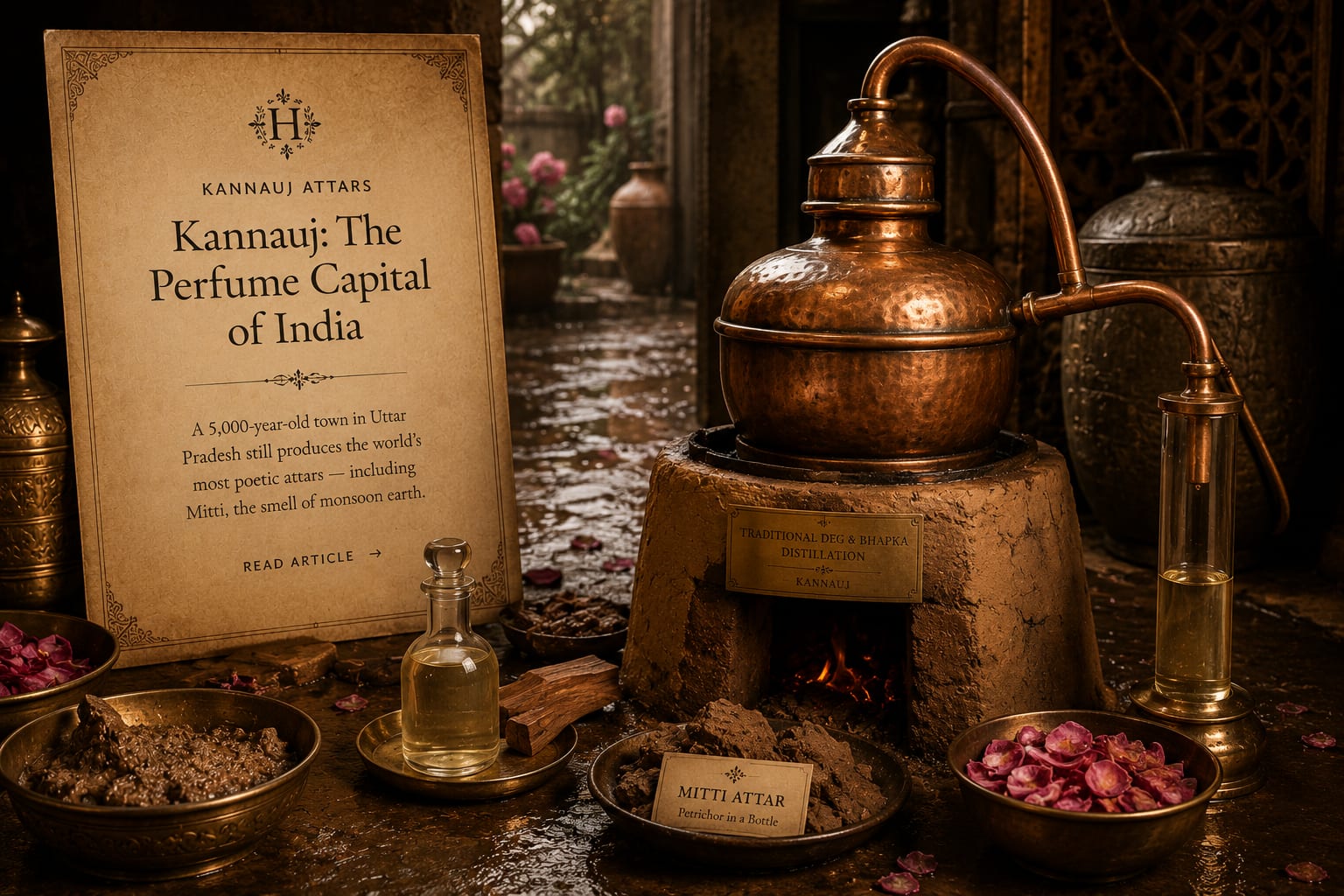
Kannauj: The Perfume Capital of India
If you've ever caught the scent of wet earth after monsoon rain and wished you could bottle it — you can. The bottle is called Mitti Attar, and it comes from one place on Earth: Kannauj, a small town in Uttar Pradesh, India.
A 5,000-Year-Old Craft Kannauj has been distilling perfume since at least 1,500 BCE — references appear in the *Atharva Veda*. Under the Mughal emperors, particularly Akbar and Jahangir, Kannauj's attars were considered finer than anything produced anywhere else in the world.
Today, over 300 traditional distilleries still operate in Kannauj, most of them family-run for 5–10 generations. The craft has survived because the technique — deg-bhapka — has no industrial substitute.
What is Deg-Bhapka? It's the traditional Indian copper-still distillation method. Two vessels: - Deg — the boiling pot, made of copper, where flowers/herbs/clay are heated with water over wood fire - Bhapka — the receiver, also copper, connected via a long bamboo pipe (chonga), partially submerged in cooling water
Here's the magic: the bhapka contains pure sandalwood oil, not water. The aromatic vapours from the deg condense directly into the sandalwood, which acts as a natural fixative. No water phase is collected. The finished attar is the combined essence — sandalwood + the distilled aromatic — already integrated, already aged, already perfect.
The Attars of Kannauj Ruh Khus — wild vetiver root distilled into sandalwood. Cooling, mineral, earthy. Traditional summer attar.
Mitti Attar — sun-baked clay discs from the Ganges floodplain, distilled into sandalwood. The smell of monsoon rain on dry earth. Bottled petrichor. There is no synthetic substitute.
Gulab Attar — fresh Damask roses, distilled into sandalwood. A complete rose-sandalwood composition in a single drop.
Shamama — over 40 herbs and spices, distilled over weeks. Warm, complex, oriental. Considered one of the world's most complex perfumes.
Hina — a temple-attar with herbs, woods, and resins. Sacred, contemplative.
Why Kannauj Cannot Be Replicated 1. Water — the Ganga-Yamuna doab water has a specific mineral profile. 2. Clay — only Kannauj's alluvial clay yields Mitti Attar's true petrichor. 3. Technique — passed master-to-apprentice. No textbook captures the timing. 4. Sandalwood — the receiver oil that makes attars *attars* is increasingly rare; Kannauj distilleries have multi-generation supply networks.
A Visit Kannauj sits 80 km from Lucknow. The town smells like flowers from October through March. Distilleries welcome visitors who book ahead. If you visit, ask to see the deg-bhapka in operation — watching liquid aromas condense into sandalwood by candlelight is unforgettable.
Shop Our Kannauj Attars - Ruh Khus (Wild Vetiver Attar) - Mitti Attar (Baked Earth) - Browse all attars
How to Store Essential Oils & Absolutes (Shelf Life Explained)
Why some oils last 2 years and others last forever, the role of oxygen and UV, and how to extend the life of expensive materials.
Mitti Attar: How Petrichor Gets Bottled
The smell of first rain on parched earth, captured by distilling baked clay into sandalwood. The most poetic perfume in the world — and made nowhere except Kannauj.
Agarwood (Oud) Buying Guide: Hindi, Cambodi, and the Truth About Pricing
Real oud costs more than gold by weight. Here's how to know what you're buying, what the regional differences mean, and how to spot the fakes.