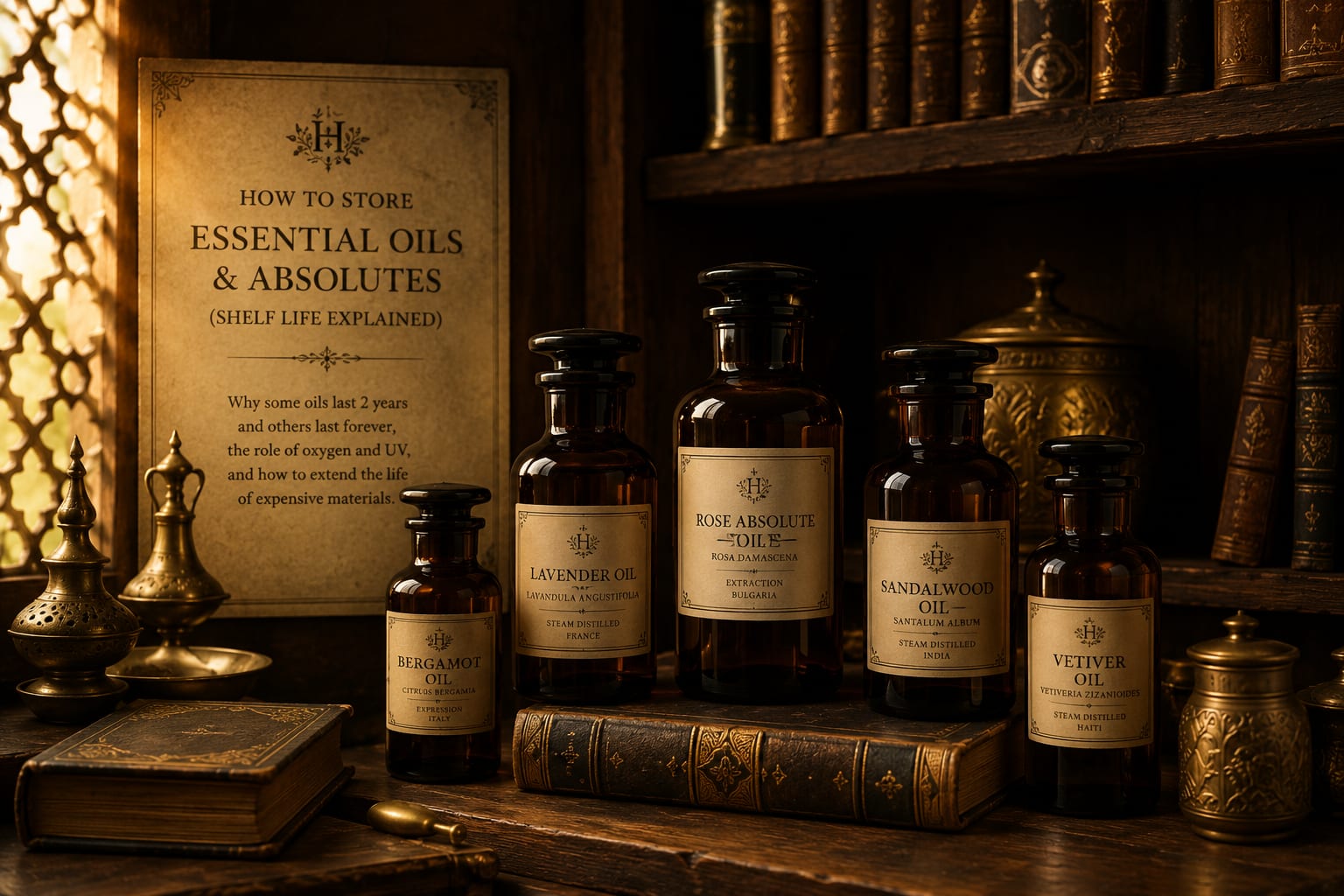
How to Store Essential Oils & Absolutes
Essential oils are not equal in their longevity. Some — like patchouli and oud — improve for decades. Others — like citrus and tea tree — start degrading within 12 months. Here's the full picture.
The Four Enemies 1. Oxygen — oxidation breaks down terpenes, creates off-notes 2. Light (UV) — accelerates oxidation, changes colour 3. Heat — speeds every chemical reaction 4. Moisture — promotes hydrolysis of esters
Categories by Shelf Life Up to 12 months (after opening): All citrus oils — bergamot, lemon, orange, grapefruit, lime, lemongrass. Tea tree. Eucalyptus.
2–3 years: Most florals — rose otto, jasmine, neroli, ylang. Most herbal oils. Lavender.
3–5 years: Most absolutes — rose absolute, jasmine absolute, tuberose. Sandalwood (improves). Vetiver.
Indefinite (improves with age): Patchouli, oud, sandalwood, vetiver, mitti attar, frankincense, myrrh, benzoin, vanilla absolute, ambrette.
Best Storage Practices 1. Amber or cobalt glass — blocks UV. Clear glass is for short-term display only. 2. Small bottles — less headspace = less oxygen. As you use an oil, transfer to a smaller bottle. 3. Cool, dark place — 10–20 °C ideal. Avoid direct sun, kitchens, bathrooms. 4. Refrigerator — for citrus oils only. Bring to room temperature before opening to prevent condensation. 5. Tight cap — every minute the bottle is open, oxygen is dissolving in.
Signs of Degradation - Citrus: turns harsh, plasticky, loses brightness → discard - Florals: faint, flat, less complex → still usable in soap, not fine fragrance - Resins/woods: smoother, more refined → use confidently
A Pro Tip When opening a fresh expensive oil (rose absolute, oud), immediately decant a small working sample into a 5–10 ml amber bottle. Use that for compounding; keep the main stock sealed. You'll triple the practical shelf life.
Our Packaging All House of Absolutes KA materials ship in amber or cobalt glass. Bulk orders (500ml+) come in dark HDPE for transit, with recommendation to transfer to glass on arrival.
Have a storage question about a specific oil? Ask us.
Mitti Attar: How Petrichor Gets Bottled
The smell of first rain on parched earth, captured by distilling baked clay into sandalwood. The most poetic perfume in the world — and made nowhere except Kannauj.
Agarwood (Oud) Buying Guide: Hindi, Cambodi, and the Truth About Pricing
Real oud costs more than gold by weight. Here's how to know what you're buying, what the regional differences mean, and how to spot the fakes.
How to Read a GC/MS Report for Essential Oils
A practical guide for perfumers and B2B buyers — what to look for in a GC/MS, how to spot adulteration, and which markers verify authenticity.