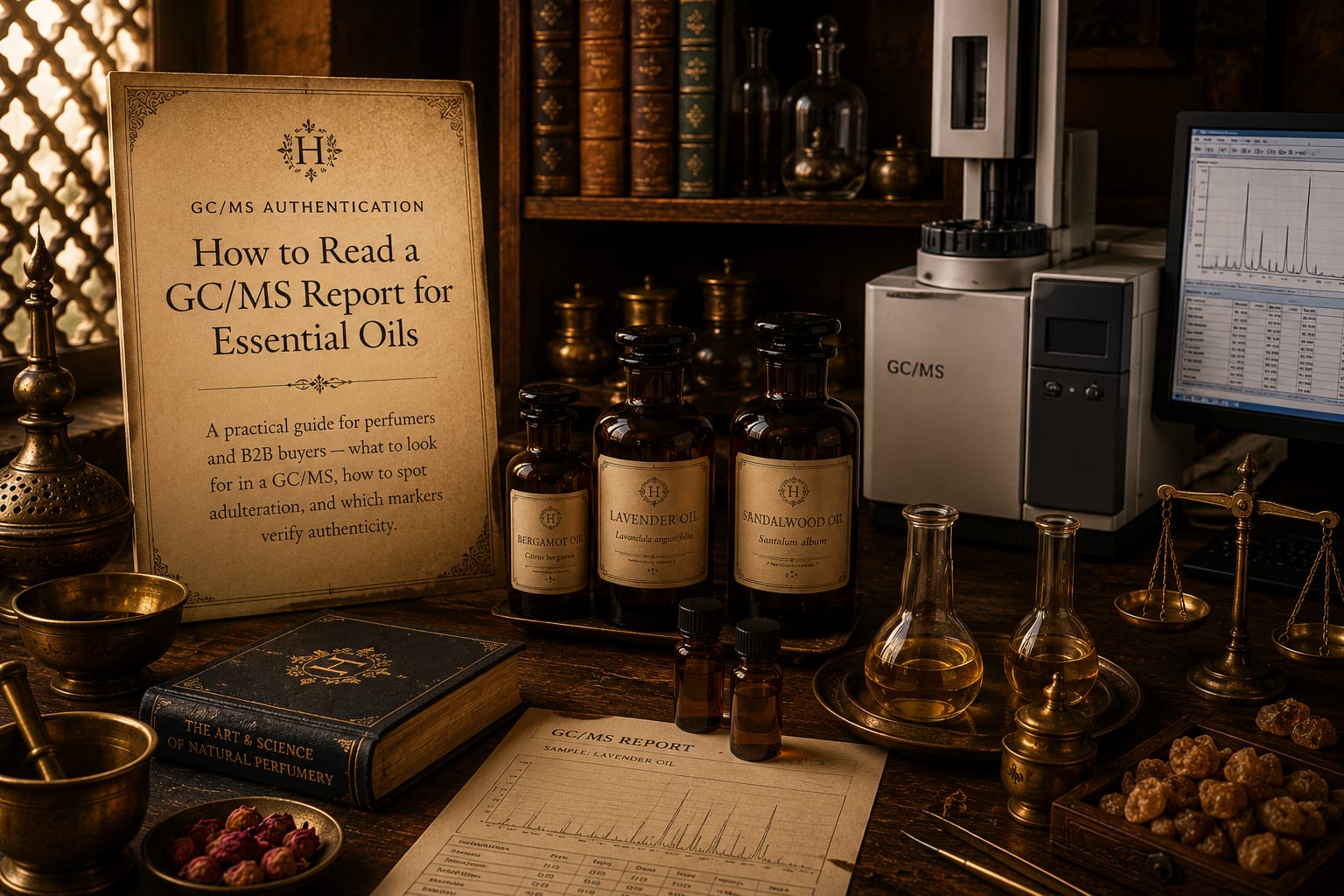
How to Read a GC/MS Report
A GC/MS (Gas Chromatography / Mass Spectrometry) report is the single most important document when sourcing essential oils. It tells you exactly what's in the bottle — molecule by molecule. Here's how to read one.
The Three Sections of a GC/MS Report 1. Chromatogram — a graph with peaks. Each peak = a molecule. Bigger peak = more of it. 2. Identification table — names each peak (e.g., 'linalool'), shows its percentage. 3. Total area % — the percentage breakdown of the entire oil composition.
What to Check 1. Is the dominant molecule correct? Each oil has a fingerprint: - *Rose otto*: citronellol (25–40%), geraniol (10–20%) - *Lavender*: linalool (30–40%), linalyl acetate (30–45%) - *Sandalwood*: alpha + beta santalol (>40% combined) - *Jasmine sambac*: benzyl acetate (15–25%), linalool, indole
If the markers are off, the oil is either from a different species or has been adulterated.
2. Are 'suspect peaks' present? Some molecules signal adulteration: - *Diethyl phthalate (DEP)* in a 'natural' oil → fragrance dilution - *Synthetic linalool* added to lavender → look for unusual chiral ratios - *Methyl anthranilate* high in jasmine? Possibly added
3. Chiral GC For premium oils (rose, lavender, sandalwood), a chiral GC distinguishes natural enantiomers from synthetic ones. Natural materials have specific chiral ratios; lab-synthesized molecules are typically racemic.
Red Flags - A GC/MS report missing percentages - A report with peaks 'unidentified' and no follow-up - A report that looks like a generic template (same date for multiple batches) - Refusal to provide a GC/MS at all
What We Provide Every batch of every product at House of Absolutes KA ships with: - Third-party GC/MS profile with full peak identification - Certificate of Analysis (COA) - MSDS (Material Safety Data Sheet) - IFRA certificate (where applicable)
Need Help Interpreting a Report? If you've bought oils elsewhere and aren't sure if the GC/MS checks out, send it to us — we'll review it free of charge for B2B buyers.
How to Store Essential Oils & Absolutes (Shelf Life Explained)
Why some oils last 2 years and others last forever, the role of oxygen and UV, and how to extend the life of expensive materials.
Mitti Attar: How Petrichor Gets Bottled
The smell of first rain on parched earth, captured by distilling baked clay into sandalwood. The most poetic perfume in the world — and made nowhere except Kannauj.
Agarwood (Oud) Buying Guide: Hindi, Cambodi, and the Truth About Pricing
Real oud costs more than gold by weight. Here's how to know what you're buying, what the regional differences mean, and how to spot the fakes.