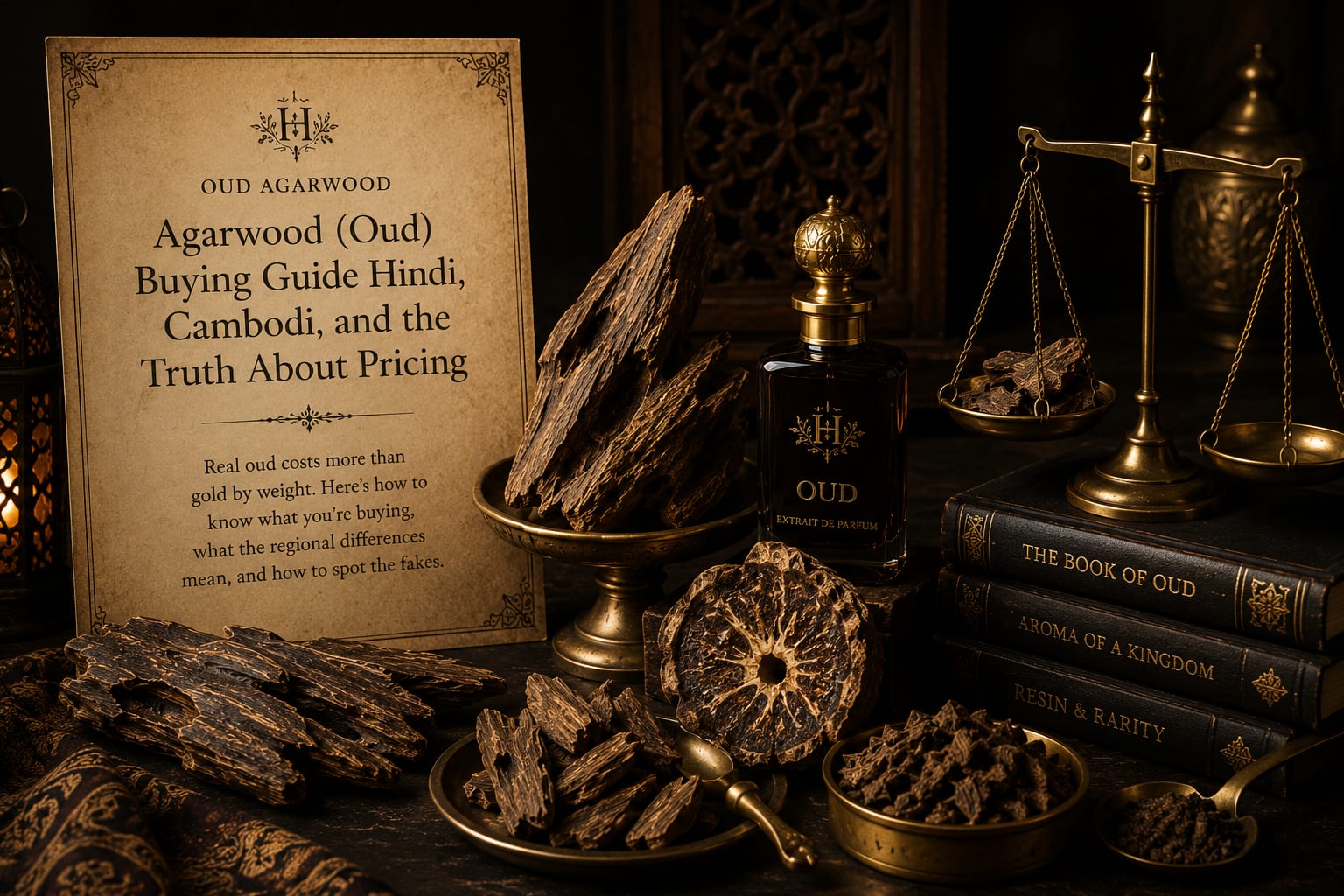
Agarwood (Oud) Buying Guide
Real oud is one of the most adulterated raw materials in perfumery. It's also one of the most expensive — premium grades routinely cost more than gold by weight. Here's how to buy with confidence.
What Oud Actually Is Oud is the resinous, dark heartwood of *Aquilaria* trees that have been infected with a specific mould (*Phialophora parasitica*). Only about 2% of wild Aquilaria trees develop this resin naturally. Cultivated trees can be inoculated, but the resulting oud is considered less complex than wild.
When the resinous wood is hydrodistilled, you get oud oil (also called dahn al-oud or agarwood oil). The wood itself is also burned as incense — that's *bukhoor* / *agarwood chips*.
Regional Profiles Hindi Oud (Assam, India) — barnyard, leathery, animalic, deep. The most traditional. Smells 'fermented' on first sniff. Beloved in Arabian perfumery.
Cambodi Oud (Cambodia) — sweet, fruity, mellower, no barnyard. Often the entry-point for Western noses.
Borneo Oud (Malaysia / Indonesia) — clean, woody, faintly floral. Very refined.
Burmese Oud (Myanmar) — sweet, slightly spicy, somewhere between Hindi and Cambodi.
Pricing Reality Check Premium wild oud sells for $300–$3000 per tola (11.7 g). If you see 'oud' at $50/tola, it's almost certainly: - A reconstitution (a synthetic perfume blend marketed as oud) - An oud blend (1% real oud + 99% sandalwood + synthetic notes) - A different wood entirely (often Bois de Rose marketed as 'oud')
How to Authenticate 1. CITES certificate — *Aquilaria malaccensis* is on CITES Appendix II. Genuine wild Indian oud ships with CITES paperwork. 2. GC/MS — oud has a complex GC/MS fingerprint. Beware of suspiciously 'clean' profiles. 3. The hot-needle test — heat a fine needle, touch the oud. Real resinated oud melts and smokes; pure oil sizzles distinctly. Adulterated material often crackles. 4. Smell on skin after 6 hours — real oud evolves: smoky → leathery → honeyed → balsamic. Fakes stay flat or disappear.
What We Stock Indian Hindi Oud — from naturally-resinated Assam *Aquilaria malaccensis*. CITES Appendix II certified. Single-source, single-lot. Each shipment includes full provenance documentation.
We do not blend, reconstitute, or extend our oud. If you need a budget alternative, ask us — we'll be honest and point you toward Indian Sandalwood or Cypriol for woody-resinous depth at a fraction of the price.
How to Store Essential Oils & Absolutes (Shelf Life Explained)
Why some oils last 2 years and others last forever, the role of oxygen and UV, and how to extend the life of expensive materials.
Mitti Attar: How Petrichor Gets Bottled
The smell of first rain on parched earth, captured by distilling baked clay into sandalwood. The most poetic perfume in the world — and made nowhere except Kannauj.
How to Read a GC/MS Report for Essential Oils
A practical guide for perfumers and B2B buyers — what to look for in a GC/MS, how to spot adulteration, and which markers verify authenticity.